
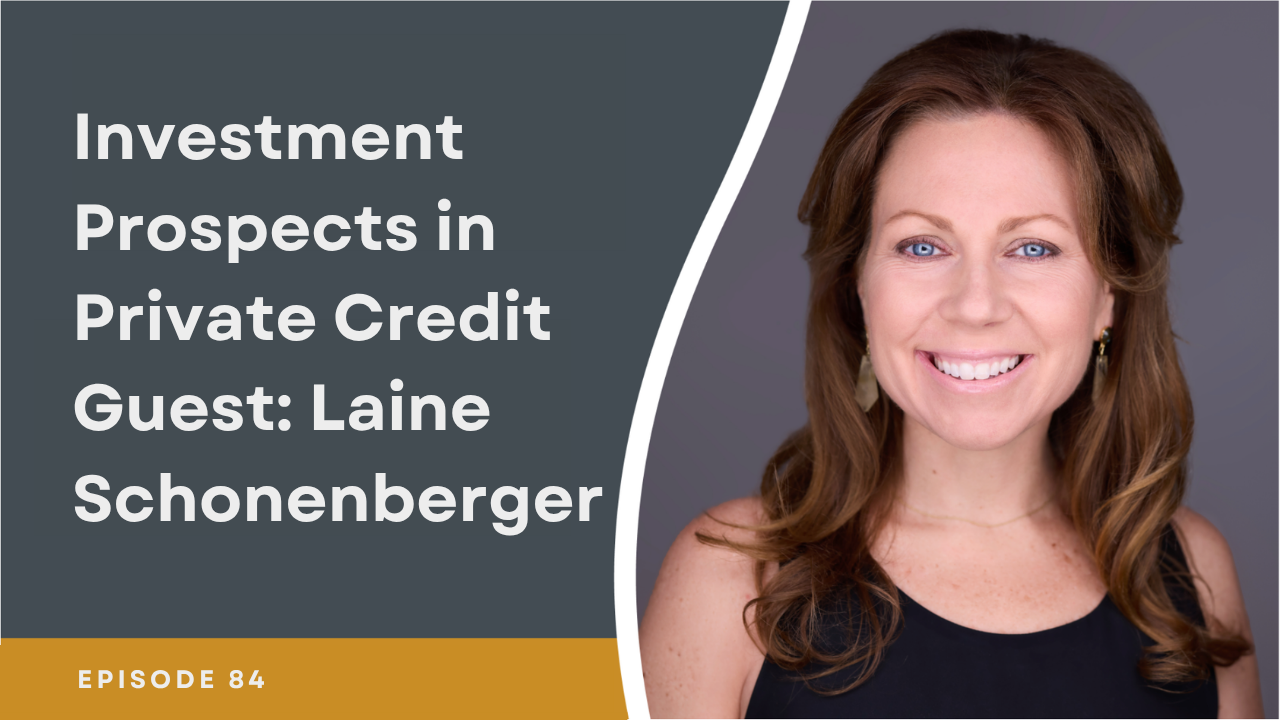
Private credit is one of the hottest alternative investments right now, and Yrefy has a truly innovative investment that serves both sides of the transaction - borrowers and investors.
Laine Schoenberger, Chief Investment Officer and Managing Partner at Yrefy, joins me to explain their platform. Yrefy helps borrowers trapped by private student loan debt while offering accredited investors attractive, non-correlated returns. Laine shares the stories behind their clients, explains how their underwriting process works and explains the advantages for investors, including flexible terms and steady, fixed interest rates.
Top three takeaways:
Real Impact for Borrowers: Yrefy’s program isn’t just about numbers; it’s changing lives. By negotiating down distressed private student loan debt and refinancing at affordable, fixed interest rates (average 3.9%!), borrowers get a custom solution that restores their credit and financial dignity.
Investor-Friendly Structure: Accredited investors can participate with as little as $50K, picking their preferred term (1-5 years) and enjoying fixed, non-correlated returns up to 10.25%. There’s also a feature that provides flexibility if early liquidity is needed.
Transparent, Human Approach: Every loan is handled in-house, borrowers are required to prove their seriousness before funding, and Yrefy’s average default rate is low (around 2%).
Private credit that genuinely “does well by doing good” — this is a case study in how investors and borrowers can both win.
To read more about Yrefy - www.yrefy.com
Take the quiz - How Alternative Assets Can Fit in Your Portfolio
Time Stamps
00:00 Welcome and Show Intro
00:24 Why Investors Choose Reverse
02:15 Reverse Exchange Complexity
03:02 Doing Exchanges Across States
04:35 Improvement Exchange Explained
06:29 How Funds and Contractors Work
08:07 Fees Timelines and Planning
09:14 When an Exchange Is Worth It
12:08 Avoiding Legal and Partnership Pitfalls
15:04 Wrap Up Resources and Contact
16:47 Final Podcast Outro
-
Podcast Welcome
Welcome to the Unconventional Investor Podcast. I'm your host, Michelle Moses, certified financial planner, licensed realtor, and founder of ME Financial. If you're an accredited investor feeling overwhelmed by managing your portfolio and looking for alternative investment strategies that go beyond the traditional stock market, you're in the right place.
Let's head into today's episode so you can start taking control of your financial future. Hello everyone, and thank you so much for tuning in.
Meet Laine From Yrefi
Today we are going to be talking about distressed private student loans, and we are gonna be talking with Yrefy about this. And it is, I'm, I know that you could listen to this and I'm possibly call Yrefy if you had a student loan, but we are gonna be coming from this.
From a investment standpoint for accredited investors and to talk about this, I have Laine Schonenberger here and he is the Chief Investment Officer and managing partner at Yrefy. He is a former financial advisor who retired in 2017 to launch Yrefy. He's a graduate of, and. Several certifications from the American College of Financial Services, including the Chartered Financial consultant, chartered Life Underwriter, and the L-U-T-C-F designations.
And as founder and chief Investment officer of Yrefy, most of his days are spent overseeing capital raises for the company, along with supporting the team and product design and implementation. Thank you so much for being here. Pleasure's mine. Thank you for having me. Yeah. Laine, we have to be totally honest.
I met with you many years ago. It's been a long time. Yeah, it's been a long time. I have always thought that this investment was very interesting, but then when I talked to people, they weren't that interested. My set of clients were not that interested, but I have been, at meetings and things and heard your name and heard the company name and so I'm really glad that you could be on here 'cause I do think that this is a good investment.
Oh, thank you. I appreciate the opportunity. Yeah.
Private Vs Federal Loans
You guys, so whYrefy? Basically Yrefynances distressed private student loans. So we are, let's get that out of the way. Right now we are not talking about federal student loans. That's right. It's generally the first question we get asked is can you have refinance a federal student loan?
The answer's no, we don't do any federal student loans and really the question behind that. Is what happens if the government forgives all the student loans. That's really what exactly the potential, what's the news, what you're asking. Yeah. And at the end of the day, again, we don't do any federal, strictly private.
And if there was some kind of forgiveness of federal, which I don't think there will be under this administration, but if there were, it would actually help us and it would help our borrowers. And the reason very simply is most borrowers that have private student loans also have federal. So if you free up the cash flow from getting rid of their payment, it helps us and it helps our borrowers.
Okay. So we're not worried about it. It doesn't really affect us at all. And so you're saying most people have both if they have a mix, yeah. They gen generally have a mix. If they have really private, they generally have federal as well. Okay. Yep. And so you're talking private loans, is it more so they see what they can qualify for federally and then they fill in with the private student loans?
Is that Yeah.
How Defaults Happen
The way that it works usually, so they go off to school, outta college or outta high school and into college and. They obtain their financing one of many ways, one of which is they hit the finance office and it's a federal student loan first. The free application for federal student aid or the FAFSA app.
The government doesn't lend a hundred percent of what you need. You also have your grants, loans, scholarships, et cetera, grants and scholarships rather. And then if there's not enough money, or mom and dad or whoever hasn't saved it up or you're not working, you have to go to the private side and get private student loans.
So the interesting thing about those is they're still bankruptcy protected. They still have all the bankruptcy protections that federal student loans have. So when a borrower needs to get more money, that's their only recourses to go out and get those private loans. They're credit based, most of 'em, mom and dad or grandma, grandpa, someone co-signs.
So now they've gone to school and they're done. Now they're out in the real world, and that's where we step in, right? Because they've gone out, something went wrong in their world, whatever it was, it might've been, they got the job but they had to start at the bottom and work their way up. Or maybe it took a little longer to get the job than they thought.
And because of that, their payment wound becoming delinquent and ultimately went into default. The problem with student loans in the federal side, there's all kinds of programs to help people. On the private side. There is no real way out, okay? If you go into distress on your student loan delinquency first you got your late payment, late payment, then you slip into the default interest rate, which is always double digits, and then you find yourself sliding down a very slippery slope where it's impossible to get out of.
Now you're going to collections. They destroy your credit. Mom and dad's credit, grandma and grandpa, whoever co-signed. And things start to get really ugly very quickly. And of course they're moving towards collections, judgment, garnishment of wages. That's their ma that's their recourse.
Bankruptcy Reality Check
And what you say when it's protected from bankruptcy, it basically means you can't discharge it in a bankruptcy.
So there's, with student loans you can get rid of or when you go through bankruptcy, you can get through a lot of things or Yeah. Have a lot of things discharged. But student loans, private or federal are not one of those things. Correct. Okay. Student loans and taxes or the two things you can't get out in a bankruptcy.
Student loans. And I've had people challenge me, so just let me put it out there. Student loans. The only way you can bankrupt out of a student loan is you have to go through what's called the burner test. There's three prongs. They're very hard to meet, and it's all three. It's not one or two, it's all three.
And it basically is, at the end of the day, it is 1000000%. You cannot afford to pay this loan back. It's a burden. And you meet all of these requirements, which are really high bars to hit. Very few people have ever actually made it through the burner test and passed. Okay. So can you get out?
Yeah. Yeah. But you're living a destitute life, right? Under a bridge kind of thing. Right? It's bad. Yeah. What we're doing is, borrowers, were looking for a way to pay the debt back with dignity. We gave them that path, right? They're, these are not borrowers looking for a free ride.
These are borrowers that are, Hey, I need a path to pay this back. And I just, I'll somebody, please show me the way.
Yrefy Underwriting Process
And so could you walk us through like your process of what happens? Absolutely. So borrowers first, first and foremost is really important. Part of this is they contact us. We don't do any outbound phone campaigns.
Okay. They have to, they have to find us. How do they find us? Dave Ramsey endorses our borrower product. That's one. We do a lot of Google Pay per click advertising. So they're online, they type in certain keywords, they'll find us and be driven to our website. There's also the, relationships that we have with the lenders, servicers, collection agencies, law firms, wherever the debt is, and they'll actually do a live transfer of the borrower from their call floor to our call floor.
So the borrower calls in, we explain our program, co borrower, if there's a co borrower, if they're gonna need a co borrower, we explain the program to them. The process at this point is very similar to getting a mortgage. There's an application we need to see, tax returns, pay stub, proof of employment, all the things that you would normally go through in an underwriting process.
Now we do pull credit. Here's the very interesting thing though. We're pulling that credit so we can build what we call a student loan story. We wanna learn about that borrower, their situation, what their, what's happened, how'd they get here, where are they going? And with that, we can also calculate what their estimated payment would be with us.
Should we fund a loan. We're not looking at their FICO score. We do not underwrite on FICO. We could care less what it is when, and there's a reason. So we're building the score. It makes sense. 'cause if they're delinquent then their FCO score would be in the Yeah. It's bad. You're looking for more pattern than you are looking for the score.
Yeah. We're looking for pattern, but more importantly we're looking for their ability to repay us. Our number one rule is the borrower must be able to comfortably afford the yfi payment. Okay. And I'll tell you some statistics on FCO scores here in a second. So the borrowers now, they've applied it's, they're going through this underwriting process.
We're able to calculate what their payment would be with us if we were to approve their loan.
Escrow And Settlement Model
Well, they're required to set up an escrow account and start making that payment right now while we're underwriting them. They're gonna do that for two to six months on average. That's what I always liked about your investment, was that they had an escrow.
They have to escrow. It gives us the ability to get to know them and them to get to know us. And frankly, it's the opportunity for them to prove that they have the willingness and ability to pay us back. Important. So at this point, we haven't actually done anything with their actual loan other than underwrite it.
Now, while we're doing that. We're working with the existing lender servicer collection agency law firm, wherever that debt may be, we're negotiating down the price of the debt, which will ultimately settle and pay off at a discount somewhere in 35 40 cents on the dollar. We then refinance that back to the borrower for 100 cents on the dollar, plus our 5% refinance fee.
That's the only fee we charge the borrower and we then give that borrower a custom tailored loan built around their ability to pay. Okay. Yeah.
Custom Terms And Low Rates
Are you, so are you talking about the terms, so somebody's might be five years, some someone's might be 10 years. Right? Because you kinda have to drag it out.
So the interest rate probably isn't what is the variable, but is it the time? It both are the variables, oh, really? Yep. Absolutely. Every loan is custom tailored, so these are not long-term predatory loans. These are short term custom tailored loans. Our average borrower interest rate that we charge is 3.9 fixed.
Wow. Average term right now is about 10.2 years. They're not, we're not extending them out over their lifetime or anything like that. We want to get that term as short as we can to make it comfortably where they can afford the payment. And of course, that interest rate. We don't make our money on the interest.
We make our money in the spread. The fact that we paid this asset off for 35 to 40 cents and it's worth 1 0 5. See, a lot of people stop and they say, wait, wait. You just paid this loan off at a discount. Why don't you share that discount by taking the face value of the loan down? And we could do that.
The problem is, if you do that, the borrower now has a problem with the IRS cancellation of debt income tax, right? They have to pay that difference in, in ordinary income, so we don't wanna do that to 'em. We share the discount through a low fixed interest rate and a custom term. Makes the payment affordable.
Which brings me to that part about the FO score and why we don't underwrite on FCO. Our average borrower comes to us with a low 500, high 400 FO score. Yeah, I believe it. It's not great. Yeah. Average co borrower, low 600, high 500 FO score. Again, not great. Yeah. They're probably used to getting turned down for everything.
Yeah. There's no one out there that's gonna give them a loan, much less a loan in terms we're willing to give them.
Credit Score Turnaround
What we discovered, and this is an unintended benefit, we did not get in this business to fix people's credit. Just to be clear, it was all about their student loan. What we discovered was within six to nine months of us funding a loan, we're seeing average borrower, FICO scores jump up 125 points, and a co borrower 138 on average.
So that's significant. That's life changing. So all of a sudden they become, what? What? Other credit what do you call it, other companies that are looking for people they want to loan money to, they become a good risk. And all of a sudden they're now doing it.
And they see those huge increases because of how it's reported on their credit report. You've got a settlement, which is used to be bad. Now it's good. You've gotta pay off, which is good. You've got a new loan created also good. And then all those escrow payments hit. Now they're making regular monthly payments, so they see this big spike.
Oh, so at the very beginning of it, your escrow payments hit automatically. So remember, we're collecting those escrow payments for two, two months minimum, right? We average about six. We're not fast and underwriting on purpose, right? We want to get these people to know, we wanna know them. We get to get them to know us.
We want to have a relationship before we spend any money on funding their loan. So that's why it works. It's a thing of beauty. 'cause the borrowers are actually winning. They're getting ahead. And their entire life starts to shift. As a financial advisor, FICO drives everything.
Their ability to buy a house, get a car, live, a responsible life, everything. Yeah. And I would imagine that they feel like someone's finally thrown 'em a bone. Yep. That's, there's finally something out there for people with a low FCO score that isn't in the, 15% interest rate Exactly.
Range or something like that. Yeah, exactly. Yeah. So at the end of the day it just, it works. And then you have the, so we, we say doing well by doing good, which is, then we get into the investor side of this whole thing, which we'll talk about, I'm sure. The really, the cool part and the story of this that, that I find the best is watching the borrowers win.
I get to do what's, what we call the borrower testimonials. I very rarely ever get to meet the borrower, but I get to talk to 'em sometimes on Zoom or phone or whatever we're doing. The testimonial, hearing them and their stories, how they got where they were to where they are is it fills my cup. It's really cool.
Yeah, sure. Yeah. But when you hear these stories of people who, who had. At the end of their rope. I can't tell you how many times I've heard the word suicide. Yeah, they're giving up. Yeah. That they don't know where to turn because there is nowhere when you have A-F-I-C-O like that, it's just like getting outta that is, it's impossible.
It's, yeah. There's nobody that's gonna help you out, unless you've got a family member or a friend or something. Yeah's in a law No. In something like that. Yeah. No one in the financial world is gonna help you out. This is where private credit comes in, which is what you have. So that's wonderful.
Brings us to the other side. Yeah. So hold on. Before we move to the other side.
In House Servicing Skip 12
Do you guys service the loans the entire time too? We do. You do? Okay. We do, we service everything in-house. We've built all of our technology and software around the company. Intentionally because again, it's all custom.
So there's not like some software package out there that we could go get. Your bank, they loan their money. It's always What do you have for a car loan these days? 3, 5, 7 years. And everything is it's all FICO driven. There's nothing out there. So we had to build everything to manage the whole company.
Which is great 'cause it works. And at the end of the day, we do service. Now you bring up a very good question. We offer a program to our borrowers called Skip 12. And Skip 12 is very simple. In the event a borrower has a problem, they can call us up and this is the kind of relationship we want with our borrower, right?
We don't wanna have to chase 'em around. We want them to work with us so they can call us and they can say, Hey, I got this problem. Can I skip this payment? And the answer is yes. You can skip one payment every six months for a total of 12 times throughout the course of the loan. Interestingly, pre COVID, nobody used it.
I think we had two people use it one time. It was a nice little safety net that no one really cared about.
COVID Stress Test
COVID came along and now all of a sudden you've got people that lost jobs. Things happened, and this will also talk about the, this will address the issue of, how strong are these borrowers and how strong is the portfolio?
At the peak of COVID, we had just under 23% usage of our COVID forbearance program. So these borrowers were not in default. They're not in delinquency. They just needed that month off. We basically extended our Skip 12 through COVID one month at a time. Didn't affect their Skip 12, but we just did the same thing.
So we weren't accepting payments from those borrowers 'cause they were outta work. If they're not making payments, it feels a little like a default, right? From a numbers point of view. So we had just under 23% of our portfolio not making payments. And during that time we still made every investor payment.
That's how strong the bar the portfolio is. And how much room we have for frankly defaults. Okay. Which brings me to the big question of the day. It was a good stress test. It's a great for year investment test. Yeah. And we were much smaller then. This is all pre COVID. We were only, gosh, we were only around for two and a half, three years before COVID hit.
So it was a much, much smaller portfolio and it did just exactly what we expected it to do. Now we're on the other side of that and our portfolio's substantially larger, more borrowers and it's just working, we're getting noticed. So it's, we're having a lot of fun watching these people win and get ahead.
Yeah. And I think that's what people are looking for too, is that when something goes wrong, they just want to take a month or two off. It's not, and I think you saw that. In 2008 with people's houses, they didn't necessarily want to foreclose on some people. They didn't wanna foreclose on their house.
Some people did, some people took advantage of the system, but Sure. Some people wanted to work with the bank and the, they weren't willing to. So I think this sounds more like what people would like but that the industry doesn't really put up with. Yeah.
Filtering Borrowers Upfront
I mean, at the end of the day, there's always some we get take advantage, but what we've done is we've ferret those people out on the front end through that escrow period.
Because if they don't make the escrow payments well, the other side, so there's some people that go through and they won't make the escrow payments. Absolutely. And so that's how you can tell. Yep. Okay. 'cause we have a very simple rule, right? And when we're working with that borrower, we lay it out on the very first phone call we're gonna communicate with you.
There's reasons you can fail, we're gonna communicate with you. It might be via text, phone, email, whatever. We expect a response in the absence of a response. We're not gonna fund your loan. It's just, that's number one criteria we gotta build to have a relationship here. Next one is escrow. You have to set up the escrow account, start making those payments.
You miss the escrow. We're not gonna be working together. We're gonna give you back a hundred percent of your money. You come back when you're serious and you'd be really surprised at how serious these people are and the ones that aren't fair at themselves out right at the beginning, first couple of months really, because doesn't take long.
Okay? Yep. It doesn't take long because, so they'll make a payment or two and then they're just done. Yeah, they make a payment, two payments, five payments, and then they start missing them and Okay, we, now we know where we stand before we ever funded the loan. And then you give 'em all their money back.
Give 'em back all their money and say, call us when you're serious. We'll be here. Okay. You start over. Okay. Now.
Default Rate Results
Which brings up the biggest question of all how's it doing? Meaning, what's the default rate? How's our borrowers performing over this? Over the eight years? Our aggregate default rate since 2017 when we started the company hovers around 2%.
Oh, that's wonderful. That's how well it's working. It's great 'cause you're taking people a hundred percent in default and putting it to 98% success rate. That's ridiculous. It's very cool. Yeah. We planned for a 10% default rate. That was back in 2017. We started the company. It a 10% default rate fell right in line with the private student loan portfolios of the world.
Like up everything that's out there. And you guys are at too and we're at too. Yeah. So we know these borrowers wanna get outta debt. They're looking for a path. They just needed it. They just need a olive branch or something. Exactly. And this is it? Yeah. Yep. Okay. Yep.
Fund Size Growth
And so how big is your fund now?
Oh boy. Is it one big fund? It's one giant fund. Okay. It's, gosh, by between our funded portfolio and our pipeline's growing very fast. We're sitting. About 325 million now. Wow. We're growing. That's wonderful. It's a little over 2000 borrowers in the funded side. And they're, we're funding 10 to 15 million a month right now and growing quickly.
Wow.
No Competitors Playbook
And how are there other people that do what you guys do? I've never seen, we do not have any competitors. Okay. That's wonderful. Yeah. We'll keep it that way. I didn't know if anybody had ripped you off yet. It's it's probably only a matter of time. Yeah. I will tell you, it's a very complex business.
There's a tremendous number of moving pieces. So I would tell you if someone knew how to do all of the things that we do, if they had, I call it, if they had the Yrefy playbook, right? Like I gave them the Yrefy playbook. If they had access to everything that we've built, it would probably take 'em a year to be up and running.
There's a lot of moving pieces. Okay. All right. So very unique investment.
Raising Capital Reg D
And so it's almost like you, you are looking for people on both sides. People that wanna refinance, but then also people that want to invest, essentially loan their money to all of these people that wanna refinance their student loans.
So that's the other side of the business. Which is the. Capital raise side. That's where I spend the lion's share of my time. So we built. Under what? What's called regulation D 5 0 6 C. So it's what's called an exempt offering. So it's filed with the Securities Exchange Commission.
It's not anything beyond that. It's just filed with them. So we have a private placement memorandum, we have all the sales material, et cetera.
Note Terms Returns
What we offer is to investors, accredited investors have the ability to pick and choose minimum investment's, $50,000. You can pick the duration of your investment from one to five years.
And you can mix and match, you can ladder income. It's really interesting and neat. What we built in that financial advisors, back in my day anyway, we used to build bond ladders and CD ladders and so forth. So we built this in that, with that spirit in mind. So we have a one year investment that pays 6.5%.
We have a two year that pays seven a three. That's 7.75 a four. That's at 8.5 and a five year. That's at 10.25. And what we do is we calculate interest daily and pay monthly interest payments to the investor, interest only, and at the end of their elected term or terms, they get their money back. Similar to a bond structure.
It's not a bond, it's a promissory note. It just has a lot of the moving parts like that. Of a bond. Yeah. Yeah. A lot of people understand it when you when you say that, oh, that makes sense. Yeah.
Income Compounding Controls
Then we went and got, again, we built all the software that drives all of this, the entire company. So what we were able to get a little creative and say what are investors looking for?
Maybe they don't want the income. If they don't want it, what are they gonna do with it? How about if you reinvest it or let it compound? Okay. You can do that. And what's really neat about it is in our software, you can actually go in and change your decision every month. So maybe one month you take the income next month, you don't wanna let it compound.
You can do that. Maybe you wanna take 50% of the income or 12%. Oh my gosh. Whatever works. Oh my gosh. You can do anything you want. Anything you want. Wow. You can change it monthly and you can do it by dollar amount or by percentage. So it's really a very intuitive product in that sense.
Liquidity Redemption Rules
And then we went one step further and we said, one of the problems in the alternative investment space is liquidity.
And while we we can't say we're a liquid investment. We can say we have a liquidity feature. And the way it works very simply is if the investor gives notice, they want some of, some or all of their money back prior to the end of their term. What we do is we give that investor credit for the amount of time they've been invested as a percentage of what they agreed to.
Okay? So first thing is it's at our discretion. So investor wants their money back. How fast it happens is at our discretion, we're not a bank. It's not gonna be overnight. I promise that. It's never taken us longer than 30 days to redeem somebody. Okay? 'cause there's calculations that need to be done and statements that need to be generated and so forth, but we give them credit.
So I, I always use the example 'cause it's very simple. Let's say you're in the one year note, okay? So 12 months, six months in, or 50% of the way through, client wants their money back. They get to keep 50% of the interest up to that point in time, okay? So if they were in for 80% of the time, they keep 80% of the interest and so on.
The same thing applies on the five year note. That would make sense. So the one year is 6.5% and say you're saying they'd make 3.25? Exactly. Okay. Exactly. And we just have to do the calculation. 'cause it's literally down to the day. Yeah. And that's one of the reasons it's not, we're not a bank, we can't do it like instantaneously, but we do move very quickly.
We do carry reserves 'cause we obviously wanna make sure that investors, if they want their money back, we can do it quickly. But again, it's at our discretion. Okay. We won't put the company at risk or other investors or the portfolio at risk. If someone, we needed their money back, they, once we get asked all the time what if there's a run on the bank?
The proverbial run on the bank question. We line 'em up in the order you came in. That's the order. We'll cash you out. And the portfolios generates a tremendous amount of cash flow, so it might take a month or two in the event we had to do it that way. Yeah, I always, I get the run on the bank question too, and I'm like if there's runs on the bank, we're all in deep dodo.
Chances are there's a lot more wrong in this world. Yeah. There's a lot of other stuff going on that you're also gonna be worried about and that we're all. Yeah. Yeah. In the same boat might be investing in lead and water. At that point I might be doing some other things, so I get those questions too. Yeah.
This seems pretty straightforward. There's not a whole lot. Hidden or there's nothing hidden, nothing hidden.
Roll Up Feature
And Michelle, we went a little further. We said let's give the investors some more flexibility. And so we got our liquidity feature. Then we created what's called a roll up now as a financial advisor, that term gets used in a lot of things like annuities and so forth.
The roll up in our world is if you're in the 1, 2, 3, or four year note at the end of your term, you can lock in all that interest. It's considered earned. It's the investor's money now, and they can roll up to anything above them and finish out that term at the higher interest rate. So they could do one more year at the 10.25.
Yeah. So I use this example. Let's say they're in the three year note. They've been in for three years. They got their 7.75. Whether they took the money or let it compound, it doesn't really matter at this juncture. Now they say, gosh, I sure like this. I'd like to be in that five year note. I just don't know that I can be committed for another five years.
Okay. We lock in everything at the three, and in this example, we roll 'em from the three to the five, and we'll give them two years at 10 and a quarter. If they had to get out in those last two years, we're gonna calculate on a two year timeframe, not on a five year timeframe. So the, and they can split, let's say they were in that three year and they wanted to go 50% into the four and 50% into the five or 90 10 or whatever them want creating their own little bond ladder.
Absolute. Yeah. Yep. So that's the, that's a lot of flexibility. That's a lot of flexibility. You don't hear of alternative investments that offer flexibility like that. They're not interested in managing the investor's money. No. At that kind of minutiae. No. Yeah, there's a lot of moving parts. It is a lot of moving parts and I really I don't know, congratulate you or give you accolades for doing that.
'cause most people are, it's very simple. You give us your money. And if you want it back, then it's at our discretion. And that's pretty much the talk. You may or may not get it back. Yeah. You're in the pool and congratulations, here's your statement. Yeah, this is a lot of thought going into what the investor may want and a lot of flexibility for them.
Thank you.
Why Investors Stay
Which is cool because it's like they have their money in a bank and it's not, 'cause I think what happens with alternative investments is that it's locked up for so long with. Having lack of liquidity. That by the time you reach five years. They're over the excitement.
There's no more excitement. They're done. They're ready to move on to something else that they can be excited about. Whereas this, if they're able to move things and it, I would imagine that it keeps people invested for much, much longer because they're able to manipulate it. That's one reason, another reason that people like to stay in is the interest rates are great.
Yeah. That it's a great story. Yes. That also we've got all these good things. And then you also add in the fact that this is what's called a non-correlated asset. We're not tied to the fed, we're not tied to the stock market completely and totally outside of all that world. Yeah. People incorporate these, our investment into their portfolio because they're, we get a lot of those calls where the, I'm just, I'm fed up with the stock market.
I can't do it anymore. It's too much stress. Okay. This is a fixed interest rate. The rates that we're offering that I gave earlier are all fixed interest rates. So we cannot go down. We can only go up. And we get that question a lot like are you guys gonna have lower your interest rates?
The answer is no. We can't, unless we offer a full right to rescind penalty free to all investors. That's a lot of money. Yeah. Yeah. We wanna do that. And we know that it'll work. The model's already doing it. So we know these interest rates are dialed in about perfect right now. I don't see us changing anything.
And they're good interest rates. I don't. I know people could look nickel and dime me over things and they will. Sure.
Private Credit Market
But I think those are when they would go out and look at other private, I call it like private equity pools. Private credit and you guys private credit right now is to me where people, if people call me and they're like, what should I do with my cash?
Private credit is where it's at. You. If you have cash that you can lend. With how tight the thing the things are getting with the banks'. Yeah. Interest rates. I'm not gonna bore you with the whole thing, but a lot of banks are in a lot of commercial real estate that they cannot refinance, and so they're being really tight with credit right now.
And so these private credit funds are becoming the answer. And if you have cash to lend, it is where you're gonna make the [00:26:00] most money right now at this point in time. I don't know about next year. I'm just saying right now it's a hot market. It is a very hot market for doing private credit, which is, I have had other private credit type investments on here, and it's why I called you is because I do think that this is the way things need to go right now.
Sure. No, there's a bunch of 'em out there. Yeah. And there's some really great ones. And there's some other ones that you. Yeah. Probably not a watch. Be careful. Careful. Yeah.
Due Diligence Fit
You wanna be careful of with anything. Do your, do every investor needs to do their due diligence. Even on Yrefy.
Do your due diligence. Make sure you're following through on, did you get all your answers to all your questions? Do you feel good about this? Did they give you the information that really matters? Or is it just a bunch of fluff? That goes for anything include. And does it match, some investors, they're, I'm not gonna invest anything for under 20%.
Okay, then this isn't for you. Exactly. You want something else. And, but I think for especially people going into retirement or in retirement, this might be something that's good and safe and they know how much they're gonna earn and they like that. Yep. And what's interesting is.
When you get into the private placement arena, by definition they're all speculative investments. That's just how they have to be classified. And it doesn't matter if we had an, if we don't, I'm not saying we do, if we had an FDIC wrapper on this thing, it's still considered speculative because it's a private placement.
It's the I don't know that I can explain it beyond that. It's crazy. It is crazy. It's because you are going outside the bubble of being able. To be like, tracked daily. Honestly I really think it, it's anything that can be tracked daily and that has the scrutiny of the SEC and, all of the letters, FINRA and everything.
Then it's okay, you're safe for the masses. But if it's not, priced daily for some reason it's really risky and you need to be accredited investor and the minimum is usually 25 to $50,000. Exactly. And it's what's, when you bring that up, it's very interesting because you look at the things in the stock market.
And it's almost there's this aura that can't go wrong. Yeah. I can tell you that there's a lot that goes wrong and people don't feel in control. Yeah. And I think that's what people don't like. And especially the people that really want into things like this, they're not all accredited investors and they want to be able to get into it. So I wish I could help them out, but I'm just glad you're helping at least the borrowers out. So we're helping the borrowers. Yeah.
Believe In The Widget
You know, when you're looking at these different alternatives, not just believe in their story, but believe in the widget, whatever the widget is that they've built.
It's this just not a case of, we've got this thing and you're gonna invest in it for the returns. If you don't believe in our product, then don't invest in it. It's, if we were building, if we had a widget that maybe it was something you don't believe in, whether it's for religious reasons or ethical reasons or whatever, why would you invest in it?
Yeah. So whatever the widget is that you're gonna look at, alternatively speaking, make sure that you believe in the product, not just the. It returns. Yeah. And that's what I always talk about with alternatives. Is that's what you want to, you wanna invest in things that you're excited about exactly behind it, and that you understand.
And that you're sometimes walking down the street and you're like, oh, I invested in that building in some way, shape, or form, exactly. Yeah. It's cool. And that's what people want now, right? They want that extra, yeah. When you're talking with your friends, people do this, they sit around and they talk about what they've done and what they're doing, and I invested in this thing.
I don't really believe in it, but I'm getting returns. Yeah, they're not gonna do that. Yeah, they're not gonna do that. Know, on the other hand, if you got, if this company has a good story and they like the product, they're gonna talk about it more and they're be excited about it. Yeah. And that, that makes them feel good.
Makes the person they're talking to feel everybody wins in that. So yeah, just a thought. Yeah, no, I agree. And I'm really big on, and I tell this to some of my clients too, it's like, why can't we all. Make money together without ripping anybody off. I just don't, it's possible. Yeah, it is possible. And I don't understand this whole mentality that someone has to get ripped off in order for somebody else to make money.
'cause you can all make money together. Correct. It is possible. And there are beautiful things out there where there's examples of that. So I agree. Yeah. So I'm glad that you're doing it. Yeah. Thank you. Yeah.
Wrap Up Links
So thank you so much for being on. You guys, I'll have all of Yrefy's information in the show notes, but it's y with a y.
REFY, so not WHY, it's the, that's correct. Letter Yrefy. And we'll have everything in the show notes. And if you have any questions, obviously you can call me or Elaine and go to their website and they have a pretty graph or I should say graphic with all of the returns of the one year through the five year.
And you can check it out, right? Or if you have someone that needs to refinance their student loans, you've got both sides. If you don't mind, I'll clarify. 'cause you've, we've got two websites. Oh, you do? Okay. I'm sorry. No, you're fine. The borrower side is Yrefy.com. Just letter YREFY.com. That's for all. For borrowers. If you go to invest, whYrefy? You'll see the graphics on the investment side. There's a simulator there so you can play with the simulator, all the good stuff. Okay? And if you do call us, please let us know that you heard of us on Michelle's show here. 'cause.
It's kinda important. Yeah, we'd love to know. Yes. So thank you so much for listening, everybody. I hope you got something out of this and I hope you have a wonderful day. We'll talk to you next week. Thank you.
Podcast Outro
Thank you for listening to The Unconventional Investor Podcast. I hope you feel more confident in how you can grow your wealth using the strategies I shared in this episode.
If you're ready to take the next step in diversifying your portfolio outside the stock market with alternative investments, head to me financial.net/contact us to book a 15 minute consult call with me. Let's discuss how we can work together to achieve your financial goals. Until then, I'll see you on the next episode
Disclaimer: The information provided in this podcast is for general informational purposes only and should not be construed as professional financial advice. Always consult with a qualified financial advisor or professional before making any financial decisions. The hosts and guests of this podcast are not responsible for any actions taken based on the information presented.